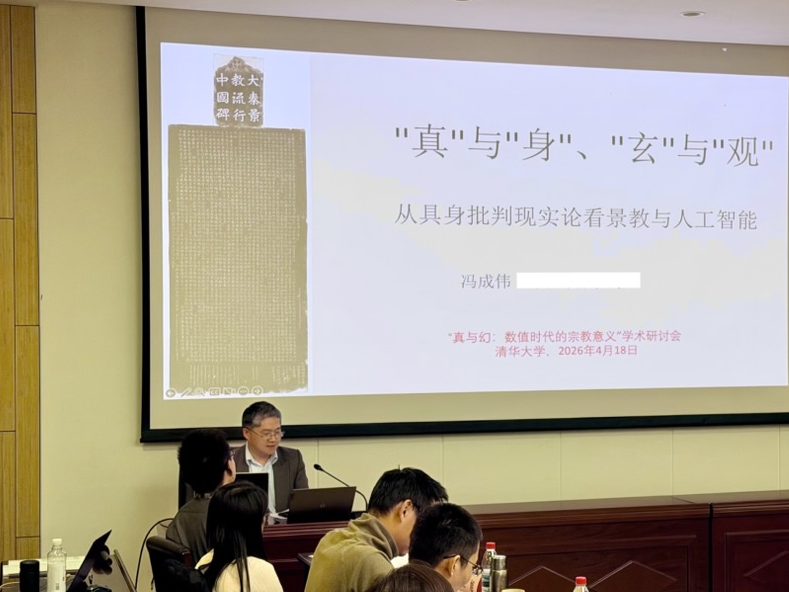
I returned to my alma mater, Tsinghua University—in the year of its 115th anniversary—to present at the symposium “Truth and Illusion: The Religious Meaning in the Digital-Intelligence Age,” hosted by the Department of Philosophy. The paper reads the Tang-dynasty Jingjiao (Luminous Religion) alongside contemporary artificial intelligence through the lens of Embodied Critical Realism.
The paper
“‘真’与‘身’、‘玄’与‘观’:从具身批判现实论看景教与人工智能” (“‘Reality’ and ‘Person’, ‘Mystery’ and ‘Inspection’: The Luminous Religion and Artificial Intelligence from the Lens of Embodied Critical Realism”).
Abstract
Contemporary generative artificial-intelligence systems—especially large language models (LLMs)—produce output by predicting the most probable next token from patterns learned across massive datasets, yet they possess no capacity to discern the true from the false. The phenomenon known as “AI hallucination” refers to AI generating false, misleading, or fabricated content while confidently presenting it as fact. Through an interdisciplinary and inter-religious study framed as a Jingjiao–Daoism–science trialogue, this paper examines the question of the “real” (zhen) and the “illusory” (huan) in artificial intelligence, treating the pair as a hermeneutical lens for the crisis of truthfulness and the problem of hallucination in AI. Tracing the etymology of zhen in the Shuowen Jiezi—where it originally denotes “an immortal transformed and ascending to heaven”—together with its rich usage in the Tang-dynasty Jingjiao documents and the Daoist classics, the paper argues that, on the basis of Embodied Critical Realism (ECR)—a theological method for a theology–science–religion “trialogue”—Jingjiao’s pairings of “real” and “body” (zhen and shen) and “mystery” and “contemplation” (xuan and guan) embody an embodied, transformative mode of knowing reality, standing in sharp contrast to AI’s “real,” which lacks grounding, embodiment, and genuine understanding. The paper first analyzes these two word-pairs in the Tang Jingjiao documents; second, it proposes ECR as a solid framework for discerning the “real” from the “illusory” within an AI–Daoism–theology trialogue; and finally, it offers contemporary philosophical and theological reflection on AI. Its scholarly contribution is to provide—through the ancient Chinese religious tradition carried by the Jingjiao documents—a theologically grounded and philosophically rigorous framework for evaluating the most pressing epistemological challenge of the digital age: distinguishing reality from AI illusion. Through the lens of Embodied Critical Realism, it discloses that the nature of the real is indispensably embodied, relational, and transformative—precisely the qualities that generative AI structurally cannot possess.
摘要 (Original abstract, Chinese)
当代生成式人工智能系统——尤其是大型语言模型(LLMs)——通过基于海量数据集学习到的模式来预测最可能的下一个词元,从而生成输出内容,但它们并不具备辨别真伪的能力。被称为“人工智能幻觉”(AI Hallucinations)的现象指的是人工智能生成虚假、误导性或捏造的内容,却自信地将其呈现为事实的情况。本文通过景教-道教-科学三元对话的跨学科与跨宗教研究,探究人工智能的“真”与“幻”问题。“真”与“幻”可作为诠释学视角,审视人工智能中的真实性危机与幻觉问题。追溯其《说文解字》的词源——“真”原指“仙人变形而登天也”,并结合其在唐代景教文献与道家典籍中的丰富运用,本文主张:基于作为神学-科学-宗教“三方对话”神学方法的具身批判现实主义(Embodied Critical Realism,简称ECR),景教的“真”与“身”、“玄”与“观”,蕴含着一种具身化的现实转化认知,与缺乏根基、具身性及真实理解的人工智能之“真”形成鲜明对照。本文将首先通过解析唐代景教文献中“真”与“身”、“玄”与“观”这两对词组,展开研究。其次,本文提出具身批判现实主义(ECR)为在人工智能-道教-神学的三方对话中辨别“真”与“幻”提供坚实框架。最后,本文针对人工智能提出当代哲学和神学反思。本文的学术贡献在于,通过研究景教文献所承载的古代中国宗教传统,为评估数字时代最紧迫的认识论挑战——区分现实与人工智能幻象——提供了神学根基与哲学严谨的评判体系,通过具身批判现实主义视角揭示真实本质具有不可或缺的具身性、关系性与变革性——这些正是生成式人工智能在结构上无法具备的特质。
Event
- Event: “真与幻:数智时代的宗教意义”学术研讨会 (Truth and Illusion: The Religious Meaning in the Digital-Intelligence Age)
- Host: Department of Philosophy, Tsinghua University (清华大学哲学系)
- Venue: Tsinghua University, Beijing, China
- Dates: April 18–19, 2026


Leave a Reply