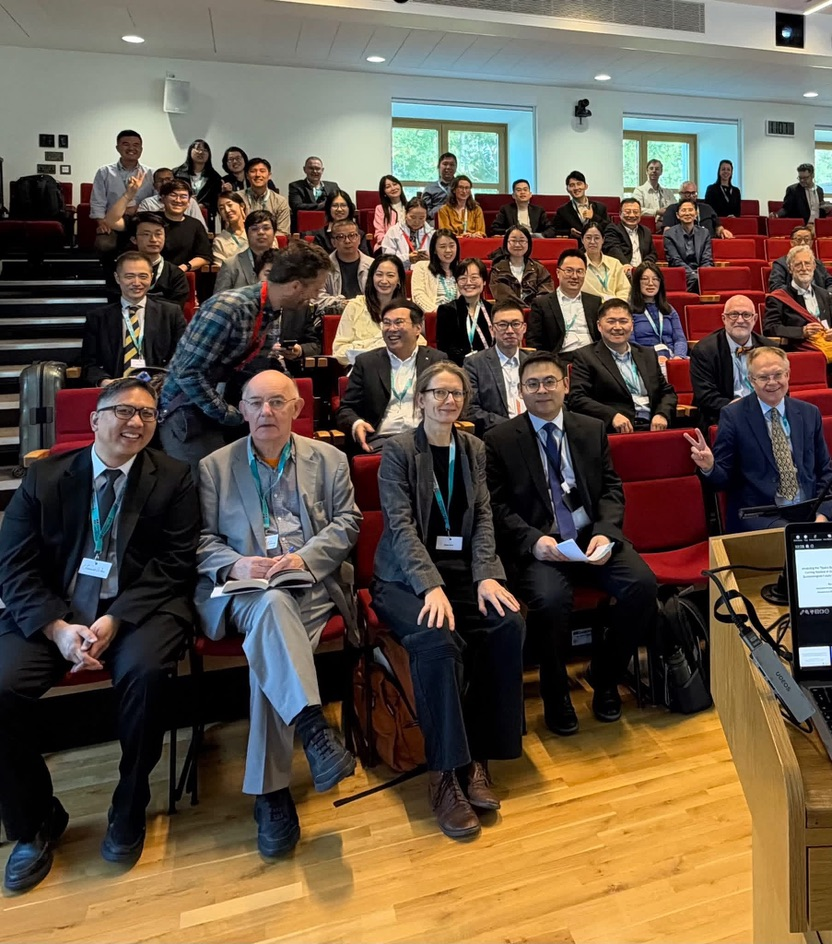
On September 23, 2026, I presented at Churches in Global Chinese Communities: Chinese Ecclesiology in the Making, the conference of the Cambridge Centre for Chinese Theology at the University of Cambridge. My paper asked what ground a corporately deified church occupies, and argued that Watchman Nee’s principle of “one locality, one church” supplies it.
The paper
“Deificational Spirituality and Ecclesiology: The ‘Local Churches’ Contribution to Global Ecumenism.”
Abstract
Elsewhere I have argued that Watchman Nee’s ecclesiology is glocal in scope, missional in nature, and ecumenical in prospect. Building on that argument and on Nee’s and Witness Lee’s well-known spirituality, this paper argues that the spirituality fostered by their ecclesial community, the “Local Churches”—a deificational spirituality, informed by their doctrine of theosis—both effectuates their ecclesiology and is demanded by it. Accounts of corporate deification in Pauline, Johannine, and Reformed scholarship each raise the question of what ecclesial ground a corporately deified body occupies and leave it standing; this paper offers a worked answer rather than a fresh discovery of the question. It first surveys the doctrine’s published reception, including the two sharpest objections it has drawn in print, then sets three practices of this community—calling upon the name of the Lord, pray-reading, and a cruciform daily living—beside hesychasm, lectio divina, and the cruciformity Michael J. Gorman finds in Paul, arguing the comparison is typological rather than genealogical. It then argues the mutual relation running in both directions between these practices and Nee’s principle of “one city, one church”: a spirituality routed through spirits joined to the Lord cannot be performed alone, and locality as the ground of ecclesiality is what obliges believers of diverse habits to the cruciformity such a spirituality entails. The contribution is twofold: a Chinese ecclesial tradition, ordinarily treated in Western scholarship as a sect or an artifact of indigenization, is shown to make a constructive contribution to a live debate in Pauline and systematic theology; and corporate deification is shown to generate an ecclesiology that has not yet been fully thought through.
Event
- Event: Churches in Global Chinese Communities: Chinese Ecclesiology in the Making
- Host: Cambridge Centre for Chinese Theology
- Venue: Selwyn College and Faculty of Divinity, University of Cambridge, Cambridge, UK
- Session: Short Paper Session 4, “Church, Spirituality, and Life,” chaired by Dr. Easten Law
- Dates: September 22–24, 2026 (paper presented September 23)


