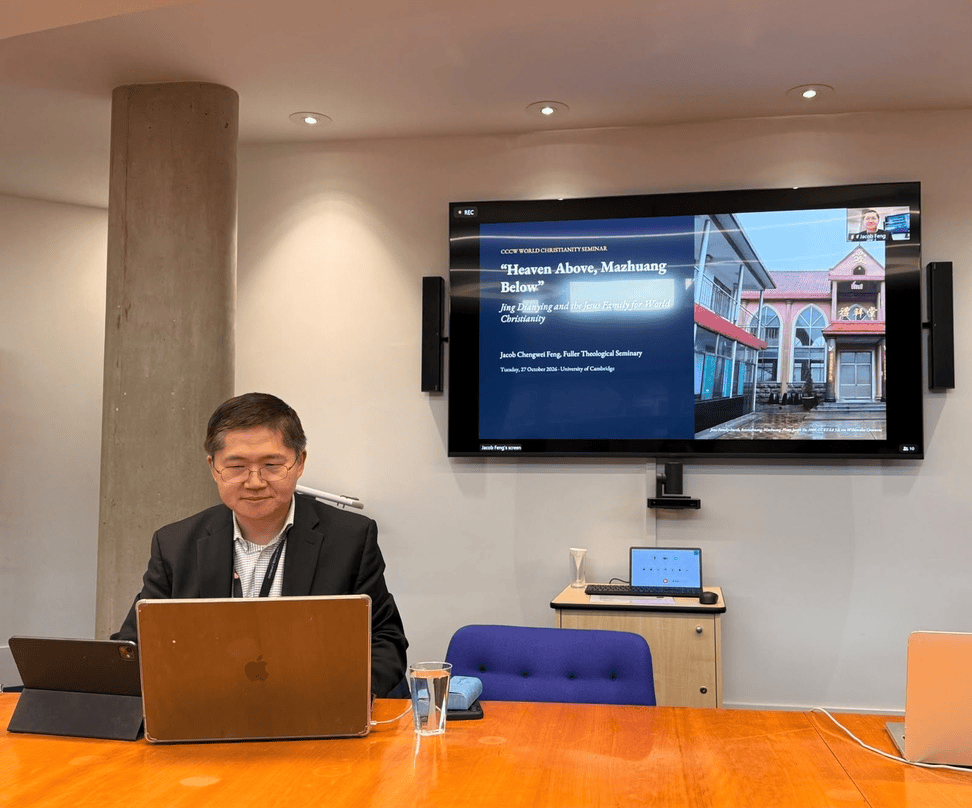
On October 27, 2026, I presented at the World Christianity Seminar of the Cambridge Centre for Christianity Worldwide and the Faculty of Divinity, University of Cambridge. My paper asked whether Pentecostal conversion is a rupture with the past or its continuation, through the hymns, letters, and prayers of Jing Dianying, founder of the Jesus Family in Mazhuang, Shandong. I am grateful to Professor Jörg Haustein, my host and moderator, and to the audience, in the room and online.
The paper
“‘Heaven Above, Mazhuang Below’: Jing Dianying and the Jesus Family for World Christianity.”
Abstract
Is Pentecostal conversion a rupture with the past or its continuation? Students of World Christianity know the debate best from Africa, where Allan Anderson has argued that Pentecostals and the older religion seek answers to the same questions but offer radically different solutions. This paper takes that claim to a Chinese case, to a different kind of evidence, and into theology, which by Anderson’s own account has approached the question only through the loaded language of “syncretism.” Jing Dianying (1890–1957), founder of the Jesus Family in Mazhuang, Shandong, came to Pentecostal Christianity after a Confucian schooling, Daoist austerities on Mount Tai, and a lifelong search for interaction between Heaven and humanity. Historians have read his movement as popular religion in Christian dress, as a refuge for the deprived, or as heresy. Jing’s own hymns, letters, and prayers tell another story: he kept a cosmological question and gave it a Christological answer, Jesus the “God-man,” and he moved from dismissing prayer as superstition to praying in tears. Drawing on my Spirit(s) and Chinese Religiosity (2026), I argue that a convert’s written theology, read critically, shows what practice alone cannot: where, in a Chinese life, the rupture actually fell.
Event
- Event: World Christianity Seminars, Michaelmas Term 2026
- Hosts: Cambridge Centre for Christianity Worldwide and the Faculty of Divinity, University of Cambridge (host: Jörg Haustein)
- Venue: Lightfoot Room, Faculty of Divinity, University of Cambridge, Cambridge, UK, and online
- Date and time: Tuesday, October 27, 2026, 4:00–5:30 PM GMT


Leave a Reply